Play 
Would you let me walk down the street naked if I want to?

Can I buy fireworks on the fourth of July?
Can I buy an amplifier on time?
I ain’t got no money now,
but I will pay you before I die.
The way things are, and the way they seem to be.
Would you let me walk down the street naked if I want to?

Can I buy fireworks on the fourth of July?
Can I buy an amplifier on time?
I ain’t got no money now,
but I will pay you before I die.
Here in Southern California, it looks like we will be rained out of the old year, and rained into the new.
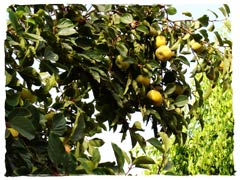
I don’t mind a bit. Last year’s deluge made this Fall’s persimmon-fest the most bountiful ever. And I’m not even going to get into the cherimoyas and the white zapotes. Yes, I have kinky fruit trees, but aside from that, I love the rain. I don’t remember if I complained about it last year, but if I did I shouldn’t have. Los Angeles, by rights, should be a desert. I read a report some years ago that said there was only enough water naturally here to support a community of 80,000 people. There are ten million of us just in LA County alone, and that’s not counting those who choose not to be counted or the ones who live outside the county but are actually part of the county in one way or another.
So when it rains here, it is a special, sacred moment, a rare blessing. It’s never enough, but while it’s happening I feel like I am part of nature, at one with the universe, instead of a squatter in a foreign land that doesn’t need or want me. Look, water from the sky! We’re saved! I don’t run outside and get all wet and twirl around in it, though. Not unless the cameras are rolling.
A lot of bloggers seem to think it’s a good idea to recap the past year, because it’s almost over and we’re starting a new one. This is helpful to me because I can barely remember what time I went to bed last night, much less what crime against reason was committed by what administration official in March (oh, yeah, it was the Terry Schiavo fiasco). Even so, I don’t pay much attention to these annual reviews. Life goes on, despite the numbers we put on the years. I haven’t figured out if it’s a circle or a straight line or maybe a downward spiral, but it does seem to be just one damned thing after another, and bundling the events of one arbitrary time period into a package to reflect on doesn’t make much sense to me.
Still, I just want to take a moment on New Year’s Eve to make a couple of observations:
That’s it. I know you’re all getting ready for tonight’s parties. Chances are you won’t see this until 2006, but just in case, when you’re all smooching and toasting each other at midnight, raise a glass for me. I’ll be sleeping in front of my television, and dreaming of you.
In the beginning there was dirt.
And the dirt was good. So good that a little tree sprouted out of it, God knows where the seed came from. Birds, probably.
Then came sun and water and after ten or fifteen years the little tree said “Now I will make some persimmons,” and so it came to pass that in the fall three hundred big, fat, sweet, juicy persimmons hung from the little tree’s branches, until the little tree cried out “Pick these things and eat of them, would you?

And so a harvest was mounted, and it was bountiful, and there was much climbing of ladders and plucking of ripe persimmons and fending off hungry mockingbirds, and there was joy and shouting in the back yard. Soon the bushels were filled with extravagant fuyus, enormous orbs of orange sweetness to rival the pear and yes, even the exalted papaya.

The harvest exceeded our ability to consume. Persimmons were eaten at every meal, pressed upon every friend, and all the relatives and every coworker until each person turned and walked briskly away when they saw us coming with our shopping bags full of fruit.
And still there were more persimmons. And they were starting to get very soft.
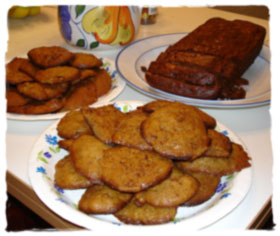
And so it came to pass that on that last Sunday in December, four days and four nights after the Solstice, the remaining persimmons were introduced to obscene amounts of sugar, butter, flour and many and varied spices – cinnamon, vanilla, nutmeg – as well as raisins, fresh lemon juice, chopped pecans, and the mixtures and batters were formed into loaves and dropped onto cookie sheets, and the baking, oh, the baking went on throughout that day and into the night, and when it was over and the kitchen was nearly as hot as the fires of hell, behold! The persimmons were transfigured into life-giving sweetbread, and verily I say to you…

cookies!!
The first day of winter, 2005.
The longest night. Maybe I won’t sleep. I haven’t stayed up all night in years. The things that once kept me up all night have faded, the urgencies, the emergencies, the crazy buzz.
I’m afraid though.
I go outside on these long nights and walk in the streets and feel alone amid the parked cars and closed up houses decorated for the big holiday. It feels good to be alone, with no false heartiness, no empty bravado, no season’s greetings. Peace on earth. Season of love, season of hope. Season of desperation.
Los Angeles is the coldest city, paved for a hundred miles. Even the rivers are made of concrete. The smiles are so hard and bright they have lost their meaning, and the brilliance of the lights hides the stars themselves.
We have defeated winter. We have put the storm windows in storage and moved to the coast and turned on all the lights and there will be no longest night, and this darkness will not seep into our souls. Winter, we have felt your chill, and we are not afraid. We will gather together with the ones we love and we will eat and sing and put lights on the roof, lights on the trees, we will light fires against the cold and dark.
Winter doesn’t care. Winter says You have to deal with me. You think you’ve escaped, but you’ve only imprisoned yourself with your decorations and your lights and your pavement and your season’s greetings. I am cold, I am darkness, and I am coming to your town, wherever you have built it, and one of these times I may decide to stay.
I’m almost alone on this longest night, just me and the silence and the parked cars. From under one of them, a small animal watches me, a cat. It is careful but not afraid, and I want to touch it, to pick it up and cradle it near my heart, feel it’s heartbeat, talk to it of spring and life, feel it’s warmth, learn it’s bravery.
But the cat knows what I want, and it runs away.
I grew up in Minnesota.

There’s still some debate as to whether I have actually “grown up” even at this late date, so let’s just say that I spent my childhood there in the Northstar state. My earliest memories of the Winter Solstice were of snow and cold and the world hunkering down against the elements. The quintessential Christmas image for me is a house – more like a cottage, really – huddled at dusk amid snow-covered pine trees. Smoke from a fireplace curls from the chimney, a golden light flickers in the windows, and snow is falling. The roof and ground are already white with the stuff, the walkway only a vague wrinkle in the soft blanket. The picture is soundless, muffled by the snow. There’s a pine wreath on the door. This image speaks peace and coziness to me. When I am inside this house, I have no concerns but to let the fire warm me and the love surround me.
Those who live in the upper midwest know what a sappy, unrealistic image this is, but I can’t help it: I’m hostage to a nostalgia for something that never was, an idyllic world of peace and tranquility that exists only in my memory. But it’s as real as any of the “real” things in my past.
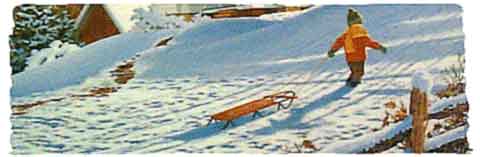
I was a child when I left the north country, so what did I know of frozen crankcases, heating bills, shoveling sidewalks and the expense of acquiring a protective wardrobe for an entire family? These were worries for my parents, but not for me. All I knew was snowball fights, diving into snowbanks, sledding, skating on the lake and the crystalline beauty of the landscape after a snowfall.
Now that I live in Los Angeles I am haunted by my snowy past. Every year at Christmas I hear the snow songs: White Christmas, Let It Snow, Sleigh Ride, Jingle Bells, Baby It’s Cold Outside, Frosty the Snowman, etc. ad infinitum, or so it seems. I hear them and the images flash in my head and I feel a disjointed melancholy as I make my way around sunny Southern California, shivering in the 50-degree evenings like some effete lotus-eating beach-dweller, which in some ways I guess I am.
But in other ways I’m still that skinny kid on a sled, racing down that steep, bumpy hill at the edge of the park again and again, oblivious to the cold, the snow that gets inside my coat and down my neck only a momentary distraction from the fun I am having, which is making me feel exactly as if I am in heaven. School is out, snow is on the ground, the sun is shining, the hill is steep and I am flying!
I can’t go home again, of course. I won’t go looking, not awake. I’ll just enjoy the palm trees in the sunshine. We have Christmas lights that hang from the eaves of the houses. We think they look like icicles. And we have inflatable snowmen with lights inside them. Sometimes we put them on our roofs, because none of us knows for sure where snowmen come from, or where they belong.
Every now and then, for no reason I can figure out, a chill floats down onto me.

Cold settles on my shoulders, and when I try to shrug it off, it only slides farther down my body, until I am shrouded to the ankles in chilly fog.
Through this fog it is difficult to see clearly the people I love. Their faces are blurry and vague. Are they smiling, or laughing? The music in me becomes distant and muffled, and I can’t make sense of it. Like the sound of a band in the gym when you are smoking in the parking lot, it has no clarity, only a dull thumping, and I can’t find the melody, can’t catch up with the beat.
The things I do seem useless. All my projects – the protest song, the ongoing writing project that is this blog, the books I want to read, the music I am trying to record, the computer I plan to build, the places I want to go – who cares? Not me, not now. Would it make any difference if I did them or not?
Sometimes I go outside late at night and stand in the deserted street and look at the sky. Even through the haze and the lights of this big city and the fat October moon I can see a few stars, and I expand into the universe and I feel huge and empty and weightless with the the stars and after a while I can see the little guy down there on the street, so small, his arms waving toward heaven, and I think What do you want?
But I get no answer. From the street, from the stars, I get no answer.
Are you the Mystery Cougher? Am I?

Today at 5:30 in the afternoon I heard the new Ricola commercial on the radio. I immediately pushed the button to switch to another station, and they were playing the same commercial. Weird, I thought, and hit the button again, and heard the same commercial again. Thinking I had somehow switched back to the original station, I hit the button again, and heard the commercial for the fourth consecutive time. These guys are really carpet-bombing us.
I was forced to figure out what it was about, and now I share with you:
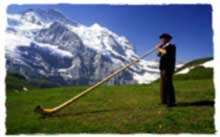
Ricola makes cough drops, and they have always had strange advertising. I remember one on TV that involved some guy in quaint Swiss folk garb blowing on a 20-foot Swiss horn in a subway car, for example.
But the current campaign is truly bizarre. They have a Mystery Cougher, a man (or maybe a woman, they hint) who goes around coughing near people. If you hear him and offer him a Ricola cough drop, BINGO! You win money, up to a million bucks! If this works, we will all have to buy at least one package of Ricola cough drops, and start offering them to anyone who coughs around us, because who can take a chance on losing a million dollars? I’m assuming this is a nationwide campaign, so that’s a lot of damn cough drops. But would you accept a cough drop from a stranger? Would you offer one? Would people call Homeland Security on you if you did?
Looks like we may find out.
I trudge up the hill, alone in the dark.

This is the hill that the kids came to in their cars all those years ago, after football games, after Friday night dances, and I can almost hear the giggling and the urgent exhortations. Boys and girls parking beneath the oil derricks on this desolate piece of land, a giant hump right in the middle of the city, lit by no light but the moon, disturbed by no sound but the grind and screech of the big oil pumps, sucking life from the hill like huge iron mosquitoes. The oil had mostly dried up ten years earlier, but a few pumps remained to make sure that every drop was sucked out. A lot of the derricks were still there, too, standing silent watch, ten-story weathered wooden lattices, relics of the drilling, no longer needed but not worth tearing down. The pumps huddled indifferently under their bases, pumping always.
Once you got to the top and parked the car, the view was breathtaking. This was before the streetlights were orange, and in the night the city stretched like a glittering sequined sheet all the way to the harbor, and the black ocean beyond could have been the very edge of the universe. You felt like you were flying, just standing there next to the car. I did, anyway. I might have been the only kid who actually saw the view, because even though I had a car, I never took a girl up there, to watch the submarine races, as we used to call it. I cruised it enough times, though, to know what it looked like, and I felt good up there alone, above it all, needing no one.
It’s the steepest hill in the region, and back then the pavement ended halfway up. Above that were just the twisting oil company access roads, dirt and gravel. No one lived up here, the derricks your only witness, except for the occasional squad car. Tonight as I walk, high-priced apartments line the freshly blacktopped roads, cheaply built boxes put here to cash in on that view, contoured into fancy-looking architectural shapes through the magic of styrofoam. The hill has been remade, too, primped up with landscaping and terraced lots for the houses, cut sharply into the earth. The derricks are all gone now, and the few stubborn oil pumps are hidden artfully behind stands of palms and local shrubs.
Once there was a nightclub at the very top of this hill. You’d drive along the deserted road in total darkness for a quarter-mile, you’d be aware of music playing somewhere, then abruptly you’d come upon a dirt parking lot lit by a few bare floodlights on makeshift poles. At the far end of the lot was the nightclub, looking like an island of corruption. An impossibly garish neon sign blinked
DANCING.
The hill had its own police department, company security left over from the oil boom, and maybe that’s why the ID check at the door was not as rigorous as in the city below. For whatever reason, my friends drank there. Come on, Jones, the Lost Boys would say. They don’t care how old you are, as long as you’re spendin’ money. I didn’t see the fascination, and my fear of being thrown out was greater than my curiosity. I regret not going now, like so many things I didn’t do.
In the end, I played in the band there, so I saw the place anyway, from the inside. I was too afraid to go in there just to see if I could fool them, but it was OK to do it if they paid me. I was not old enough to be working there, but no one ever asked about that. On stage I was a screaming showoff, shouting the blues like I meant it, but during the breaks I disappeared into the shadows, the better not to get found out and ejected. The irony of this behavior eluded me at the time. Strangely, none of my smartass friends ever saw me perform there, and eventually I came to wonder if they really ever went there.
Now I live in the shadow of the hill, and tonight I cruised it, like I used to. I don’t know what happened to the old roads. They’re not merely gone – their spirit is erased. There are guardrails and asphalt where once there were abandoned jalopies and loose gravel. Somehow, intersections and street signs have been contrived. The seedy nightclub has been razed and at the top, there’s a little park, a lookout point with a stone wall around the perimeter, concrete benches and a statue. Even the park is two-thirds paved.
I leave the car a few blocks down and walk up toward the park. I wonder if any of the boys and girls who used to make out here in cars are living in these town homes, and if so, are they living with the ones they made out with? When I reach the top there are teenagers there, some couples, some groups. I’m pretty sure I know what has drawn them here, but they are safely contained in the bright enclosure, so their natural urges are stymied.
I stand at the stone wall, and the view is still breathtaking. The streetlights below are mostly orange now – is that what makes it less magical? Or is it that we know each other better now, the city and me? I own a piece of it, and it owns a piece of me. I think about flying over the city, like I did when I was a kid, but instead I just feel like I’m falling, and in fact I stagger back from the stone wall, catching myself before I actually take off. After that I leave the teenagers behind, as I always have, and go back to my car.
When I get there, I stand by the side of the road and take in the unauthorized view for a final moment. The city has grown. It is so big and bright now that it eclipses the stars and dims the moon. It is full of living, dying, trying, crying. And out past the harbor, the very edge of the universe seems closer than ever.
I was spellbound for two hours last night watching Martin Scorcese’s Bob Dylan documentary “No Direction Home.”
Maybe it’s because of my age — I was sort of there for the original events — but I couldn’t take my eyes off the screen. What a thrilling time that was, and how exciting it must have been for young Bob and the others who speak in this film: Dave Van Ronk, Maria Muldaur, Suze Rotolo (she’s on some of the old LP covers), Liam Clancy, Joan Baez, Mavis Staples – more than I can recall. New York City, 1963. The baton is being passed from the Beat Generation to Dylan and his circle. There are a million places to play. Dylan and the others are sponges, soaking up the old guys like Woody Guthrie, and each other, learning new music, new styles, new voices, and actually saying something in their songs. It’s not a concert show, but I was still fascinated and hugely entertained. Catch Part Two tonight (Tuesday, September 27, 2005) on PBS. In Los Angeles it’s on KCET, Channel 28 at 9:00 PM, but I think it’s a national presentation. This is history, folks, but fresh enough to feel contemporary. Most of the original players are still with us.
While I’m at it, I just want to say “Hurray!” to National Public Radio’s coverage of the ongoing hurricane disasters on the U.S. gulf coast. These stories, mostly on the afternoon news show “All Things Considered,” are precious documents. Heart-warming, heart-wrenching, visceral, surprising, maddening, informative, in ways I just don’t see the mainstream media doing. The 79-year-old woman who lived alone, floating inside her one-story home on her Stearns and Foster mattress for eight days before she was rescued (“It must have a lot of wood in it…”). The New Orleans pump station worker caught by NPR’s reporter dozing on the job – because he had not deserted his post for three weeks nonstop. The man who sent his family to safety and doesn’t even know where they are, while he stayed behind to assist whomever he could in his 9th Ward neighborhood. This is why we need public radio and television, my friends. Tune in and see for yourself.
As always, my heart is yours alone. And again, I might owe some of you an apology. Please forgive my transgressions. I am socially inept, and I should know better.